logo
Home News Features People Documentation FAQ Download Tutorials Publications Press Lecture Notes Events Contacts Forum

Fortran cafe The Fortran Cafe'

Bethe-Salpeter wine The Bethe-Salpeter-Equation (BSE) wine

A street entitled to Yambo in Rome Yambo road


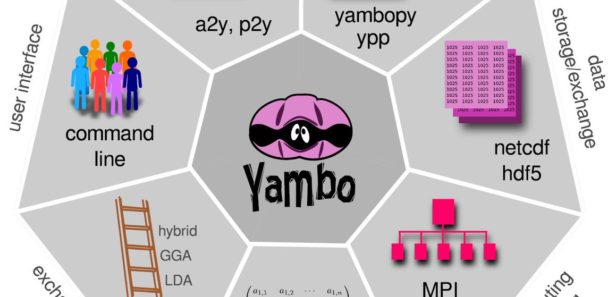
Yambo is a FORTRAN/C code for Many-Body calculations in solid state and molecular physics. Yambo relies on the Kohn-Sham wavefunctions generated by two DFT public codes: abinit, and PWscf. The code was originally developed in the Condensed Matter Theoretical Group of the Physics Department at the University of Rome "Tor Vergata" by Andrea Marini. Previous to its release under the GPL license, yambo was known as SELF.

Yambo is an important member of the key group of ab initio spectroscopy codes supported by the European Theoretical Spectroscopy Facility.

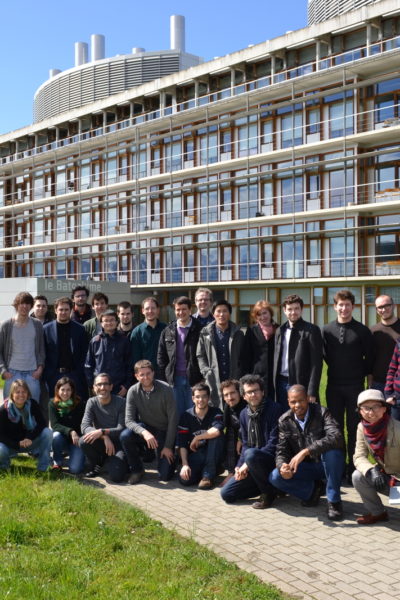
See features for an extensive overview or enjoy the view of the developers' faces.

If you want to know more follow the documentation links or read the Quick Guide and Frequently Asked Questions.

News

  • 3/8/2010
  • HPC-Europe 2: call for proposals
  • The Yambo team is pleased to inform you that the HPC-Europe 2 has opened a new Call for Proposals. Next deadlines for submitting applications are: September 15th 2010 (27th Call), November 15th 2010 (28th Call). All the applications submitted from now on will be reviewed by the new selection panel and, if accepted, funded under the HPC-EUROPA2 Project. More information about HPC-Europe 2 project on their web site.
  • 26/7/2010
  • Hands-on Workshop annoucement: nanoexcite2010

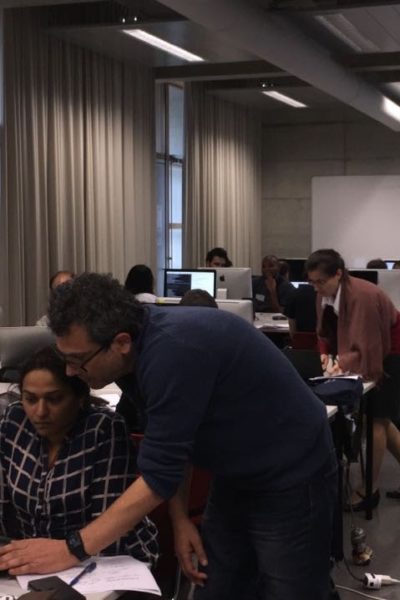
  • SISSA and CNR-IOM-DEMOCRITOS are organizing a Hands-on Workshop on electronic excitations, nanoexcite2010. The Workshop will be held at SISSA (Trieste, Italy) in October 18th-22th, 2010. The Yambo code will participate to the Workshop with lectures given by several members of the Yambo Team, hands'on classes and tutorials. The school will be attended by a maximum of around 40 participants. The school is NOT meant to introduce the basic concepts of TDDFT and MBPT and applicants are required to have already a solid background in: DFT, TDDFT, MBPT (GW and BSE) and Solid state physics. For further informations and subscriptions please visit the web-page.

  • 22/7/2010
  • Yambo on Cineca SP6, Arina and Niflheim clusters
  • Yambo has been officially installed on one of the machines of the Italian Supercoputing Center, Cineca, on the computer center of Basque Country University SGI and on the Niflheim supercomputer cluster at Technical University of Denmark. More informations can be found here: Yambo@Cineca , Yambo@SGI, Yambo@DTU.

  • 9/7/2010
  • Note on revision numbering
  • Regular users of the Yambo repository will notice that the revision numbering has apparently been reset to 1: this coincides with the creation of a separate Yambo GPL source on QE-forge (see the forum announcement for details). The new repository contains the source files for the first official tarball releases (3.1.2 (r300), 3.2.0 (r315), and 3.2.1 (r448) are present as new revisions 1, 2, and 3), as well as newer commits. However, Yambo still internally makes use of the old revision numbering, as seen in the report files, e.g. new revision 4 outputs:

    # GPL Version 3.2.2 Revision 616
    Thus when reporting problems, make sure to quote the internal revision number!

  • 7/6/2010
  • Yambo GPL repository now on-line!
  • The Yambo repository and download page have been moved on the QE-Forge. QEforge is a web portal offering an integrated software development environment: CVS or SVN repository, mailing lists, public forums, download space, wiki pages and much more. QEforge is hosted and maintained by the Democritos National Research Center, in collaboration with SISSA eLab. The goal is to make QEforge a prime source of scientific software for scientists all over the world. More informations in the Download page.
  • 7/5/2010
  • Yambo: for all your high-quality publication needs!
  • The publication of Phys. Rev. Lett. 104, 226804 (2010) brings to 14 the number of articles using Yambo to appear in Phys. Rev. Letters, not to mention an Applied Physics Letters in 2010 and two Nano Letters in 2009. We are particularly happy to see papers gradually appearing from independent users, who have benefitted from our decision to release a GPL version of the code back in September 2008. With the User Forum growing in popularity, we sincerely hope this trend continues!
More news here